
Is My Child’s Speech Normal?
Speech Sound Development Milestones by Age – A Parent Friendly Guide
Many parents wonder whether their child's speech is developing as expected.
Questions like "Should my 3-year-old be saying their sounds clearly?" or "Is it normal for my child to say 'tat' instead of 'cat'?" are incredibly common.
Understanding typical speech sound development can help you know what to expect as your child grows and when it may be helpful to seek support from a paediatric speech pathologist.
Many children follow a predictable pattern when learning speech sounds—even though every child develops at their own pace. This guide uses Australian research and clinical guidelines to help you understand what is generally typical at each age. It outlines common speech milestones by age, including speech clarity, sound development, and signs that may indicate additional support could be beneficial.
First, a reassuring note for parents
Speech development is a journey - not a race.
Children learn sounds gradually over time
Some sounds are easier and hence come earlier
Others are more complex and develop later
What is Speech Sound Development?
Speech sound development refers to how children learn to produce the sounds needed for clear speech.
As children grow, they gradually learn:
How to coordinate their lips, tongue, jaw, and palate
How to combine sounds into words
How to produce speech that others can understand
Some sounds develop early, while others take longer to master.
Understanding what is typically expected at different ages can help parents identify when additional support may be beneficial.
In fact, most children are still learning speech sounds until around 7–8 years of age.
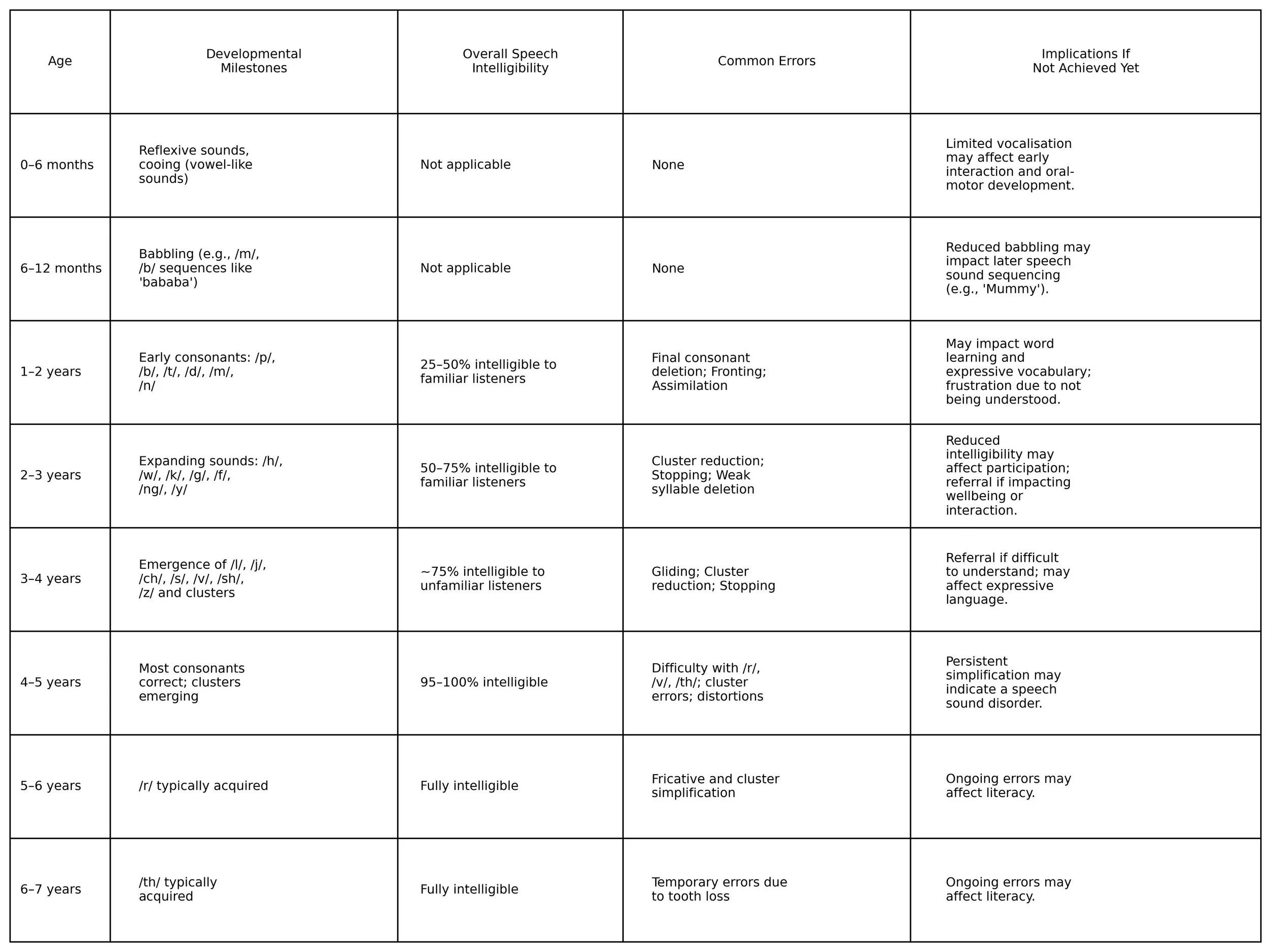
What To Expect At Each Age
What Kinds of Speech Errors Are Normal?
As children learn to speak, they often simplify sounds. These are called phonological processes, and they are a normal part of development.
Common examples include:
Final consonant deletion: “ca” for “cat”
Fronting: “tar” for “car”
Cluster reduction: “pane” for “plane”
Gliding: “wabbit” for “rabbit”
These patterns typically disappear as your child’s speech system matures.
A Note About Milestones
These milestones are intended as a guide rather than strict rules.
Some children:
Reach milestones earlier than expected
Reach milestones later than expected
Are easier or harder to understand for a period of time
Develop speech sounds through everyday exposure and interaction without requiring therapy
Variation is normal, and milestones should always be considered alongside the child's overall communication skills and participation.
When Should You See a Speech Pathologist?
You may want to check in with a Speech Pathologist if your child:
Is hard to understand for their age
Becomes frustrated when communicating
Uses very few sounds or words
Continues to use “immature” speech patterns past the expected age
Is difficult for people outside the family to understand
Their speech affects their confidence and efficiency in building meaningful relationships with peers and adults
If you're unsure, a speech pathology assessment can provide reassurance and guidance.
Why Early Support Matters
Speech development is closely linked to other areas of development. Difficulties with speech sounds can sometimes be associated with:
Oral motor skills
(how the lips, tongue, and jaw move)
Feeding or swallowing difficulties
(e.g., chewing, managing textures)
Language development
(understanding and using words and sentences)
Hearing or processing differences
Identifying concerns early helps ensure your child receives the right support if needed.
If You’re Unsure, Seek Advice Early
It’s common to hear advice to “wait and see” — but if you’re unsure, it’s best to seek guidance early. Not every child can “grow out of it” without therapy.
Early support:
Provides reassurance
Identifies whether support may be beneficial
Helps prevent frustration and communication breakdowns
Is often quicker and more effective
Can identify (or rule out) other underlying difficulties
Frequently Asked Questions About Toddler Food Refusal
At what age should my child be understood by strangers?
Most children are approximately 75% intelligible to unfamiliar listeners by 4 years of age and close to 100% intelligible by 5 years.
Is it normal for my child to say "wabbit" instead of "rabbit"?
Yes. This pattern is called gliding and is common in younger children as they learn more complex speech sounds.
What if my child understands everything but doesn't speak clearly?
Some children have age-appropriate language skills but difficulties producing speech sounds. A speech pathology assessment can help determine whether support may be beneficial.
Can speech sound difficulties affect reading and spelling?
Yes. Speech sound development and literacy development are closely linked. Difficulties with speech sounds can sometimes impact phonological awareness, reading, spelling, and written language.
Looking for a Speech Pathologist in Sydney?
At Eat Speak Play, we support children with speech sound development, language, literacy, feeding, and communication needs across Maroubra, Sandringham, the Eastern Suburbs, St George, and through online therapy.
Whether you're concerned about your child's speech clarity, speech sounds, or overall communication development, our team is here to help.
👉 Book a Free Discovery Call with one of our speech therapists.
References
Crowe, K., & McLeod, S. (2020). Children's English consonant acquisition in the United States: A review. American Journal of Speech-Language Pathology, 29(4), 2155–2169. https://doi.org/10.1044/2020_AJSLP-19-00168
Child Development Institute. (n.d.). Speech sounds developmental chart. https://childdevelopment.com.au/resources/child-development-charts/speech-sounds-developmental-chart/
Ivanhoe Speech Pathology. (n.d.). Speech sound development. https://ivanhoespeech.com.au/speech-sound-development/
Speech Pathology Australia. (n.d.). Communication milestones. https://www.speechpathologyaustralia.org.au/Public/Public/Comm-swallow/Speech-development/Communication-milestones.aspx
Adventures in Speech Pathology. (n.d.). Speech sound development chart for speech therapy. https://adventuresinspeechpathology.com/product/speech-sound-development-chart-for-speech-therapy/